
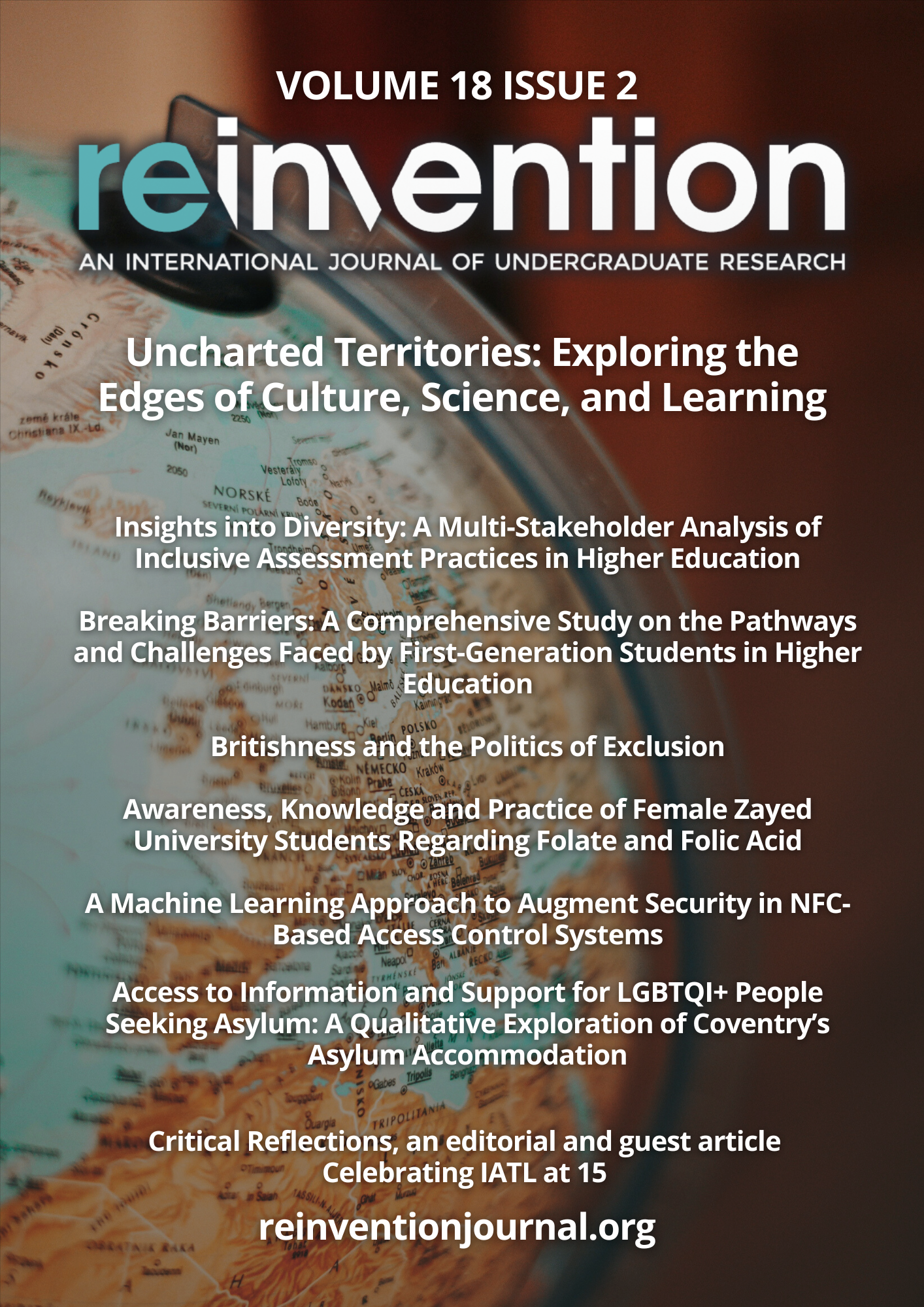
IATL at 15: Educational Innovation Then, Now and in the Future
DOI:
https://doi.org/10.31273/reinvention.v18i2.2088Keywords:
Educational innovation, Institute for Advanced Teaching and Learning, Open space learning, Student as producerAbstract
The paper traces the evolution of the Institute for Advanced Teaching and Learning (IATL) at the University of Warwick as it marks its 15th anniversary. Since its formation in 2010, IATL has served as a catalyst for educational innovation, championing interdisciplinary learning, undergraduate research and student–staff co-creation. The authors reflect on IATL’s foundations in Open-Space Learning (OSL) and Student-as-Producer, its development as an academic department and its influence on sector-wide conversations about agential learning and innovative assessment. They conclude with a discussion of possible directions of travel for educational innovation in the next decade, including the challenges and opportunities of artificial intelligence.
References
Published
Issue
Section
License
Copyright (c) 2025 Professor Jonathan Hickman-Heron, Dr Fraser Logan

This work is licensed under a Creative Commons Attribution 4.0 International License.
Authors are responsible for obtaining permission from copyright holders for reproducing through any medium of communication those illustrations, tables, figures or lengthy quotations previously published elsewhere. Authors are also responsible for adding these permissions to the acknowledgement footnote that precedes all other notes or crediting the source and copyright of photographs or figures in the accompanying captions.
The journal's policy is to ask authors to grant us the licence to publish their work, which gives us the exclusive right both to reproduce and/or distribute their article (including the abstract) in printed, electronic or any other medium, and in turn to authorise others (including Reproduction Rights Organisations such as the Copyright Licensing Agency and the Copyright Clearance Center) to do the same. In return the author(s) assert their Moral Right to be identified as the author, and we promise that we will respect their rights as the author(s). That is, we will make sure that their name(s) is/are always clearly associated with the article and, while they do allow us to make necessary editorial changes, we will not make any substantial alteration to their article without consulting them.
Copyright remains with the author(s), however, the author(s) authorise us to act on their behalf to defend their copyright if anyone should infringe it, and to retain half of any damages awarded, after deducting our costs. The author(s) also retain the right to use their own article (provided they acknowledge the published original in standard bibliographic citation form) in the following ways, as long as they do not sell it or give it away in ways which would conflict directly with our interests. The author(s) is/are free to use their article for the internal educational or other purposes of their own institution or company; mounted on their own or their institution’s website; posted to free public servers of preprints and/or articles in their subject area; or in whole or in part, as the basis for their own further publications or spoken presentations.
If you have any queries about copyright please contact reinventionjournal@warwick.ac.uk